

The artificial intelligence boom has so far been read through a single window: tech equities. Nvidia, Alphabet, Meta, Amazon, and Oracle draw the attention because their capital spending on chips and data centres keeps climbing.
But another part of this story is growing far faster than the attention it receives: the debt being used to finance that expansion.
The distinction matters. The equity market asks whether AI revenue is large enough to justify the valuations. The bond market faces an entirely different question: who is going to absorb hundreds of billions of dollars of paper with maturities running decades out, and what compensation will they demand for doing it?
The scale has already outgrown internal cash flow
The figures come from different definitions, but they point the same way.
- Goldman Sachs estimates global AI investment of roughly US$1 trillion in 2026, with around US$581 billion of it located in the United States.
- Over a longer horizon, Goldman estimates roughly US$7.6 trillion of cumulative investment in compute, data centres, and power infrastructure across 2026–2031.
- The Dallas Fed puts data centre investment needs at roughly US$3 trillion to US$5 trillion over the next three to five years.
- The Dallas Fed also notes that roughly US$500–600 billion of AI-related investment since 2023 has been funded largely from companies’ internal resources.
That last point marks the turning point. A company can finance part of an expansion from operating cash flow. Financing several trillion dollars of infrastructure without going to the capital markets is a different problem entirely.

These figures should not simply be added together. The US$7.6 trillion estimate covers the entire infrastructure stack, while the Dallas Fed estimate focuses on the data centre investment wave. The simpler conclusion: an industry spending roughly US$1 trillion a year will generate new claims on credit markets in the hundreds of billions annually, once internal cash stops covering the majority of incremental investment.
Tech companies have started borrowing at scale
The deals are no longer small.
- Oracle issued US$18 billion of bonds in September 2025.
- Meta issued US$30 billion in October 2025, then returned with US$25 billion in April 2026.
- Alphabet issued US$20 billion in February 2026.
- Amazon issued US$37 billion in March 2026 and roughly US$25 billion in July 2026.
- In August 2026, Alphabet issued a A$5.5 billion Kangaroo bond (around US$3.9 billion) in the Australian market.
One caution is worth holding onto when reading that list. In their SEC filings, most of these issues state that proceeds are for general corporate purposes, not funds legally ring-fenced for a specific GPU cluster or a specific data centre. Oracle’s prospectus is slightly more explicit, citing possible use for capital expenditure, debt repayment, investments, dividends, and buybacks.
Calling every dollar of those bonds “AI project debt” is therefore inaccurate. The stronger, more defensible claim is that this issuance expands funding capacity at precisely the moment AI capital spending is surging.
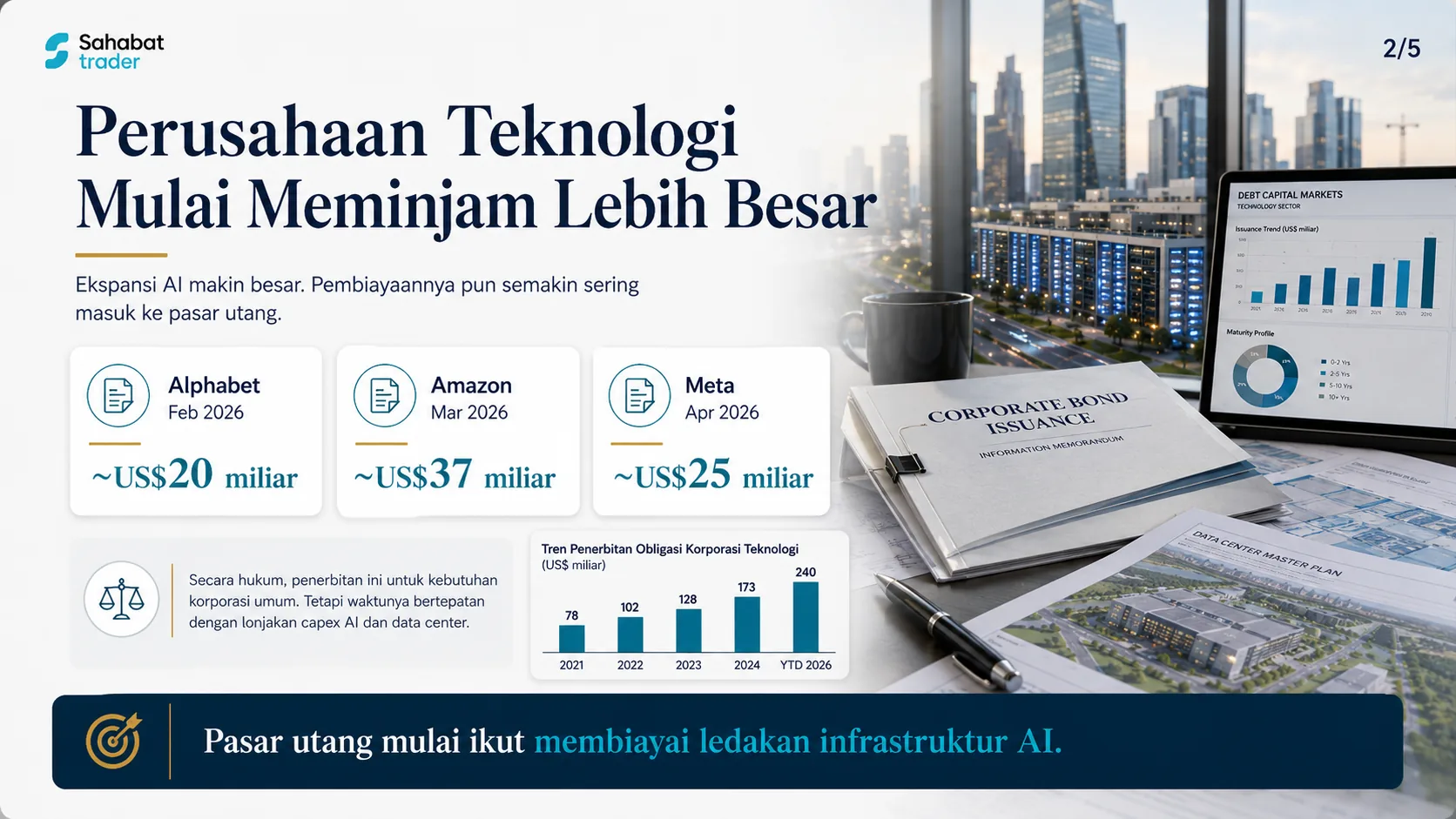
The shift also shows up in market composition. S&P records the technology sector rising to 16.7% of global non-financial corporate bond issuance in 2025, up from 11.6% in 2024. The Dallas Fed itself cites Wall Street estimates centred on roughly US$300 billion of AI-related investment-grade issuance in 2026.
What pressures the market is not the amount but the duration
This is where the analysis sharpens. A US$1 billion five-year bond and a US$1 billion forty-year bond do not impose the same interest rate risk on investors.
So the Dallas Fed converts that issuance into ten-year Treasury equivalents, the standard way of expressing how much duration the market has to absorb. The result: roughly US$300 billion of investment-grade issuance can produce up to US$360 billion of ten-year-equivalent duration, or roughly one-eighth of Treasury duration supply.
This does not mean AI debt is one-eighth the size of the Treasury market. What is one-eighth is the interest rate sensitivity that fixed income portfolios have to house.
The logic runs like this:
more long-dated debt → more duration investors must hold → more interest rate risk in the market → the compensation demanded can rise
That compensation shows up as higher yields, a change in the shape of the curve, or a larger term premium.

It is the maturities that make the difference real. Meta has issued out to 2066, Alphabet to 2066, and Amazon to 2076. Investors are not merely lending large sums; they are locking in interest rate exposure for decades.
Private credit and swaps: the duration you cannot see
Not all AI financing appears in the public bond market, and this invisible portion is one of the most important parts of the story.
Reuters reported UBS data showing AI project and data centre financing reaching roughly US$125 billion in 2025, up sharply from around US$15 billion in the comparable reporting period a year earlier. Morgan Stanley estimates private credit could supply more than half of roughly US$1.5 trillion in data centre buildout needs through 2028. On the securitisation side, S&P records global data centre securitisation issuance exceeding US$30 billion in 2025, up from just over US$10 billion in 2024.
Project loans like these are generally floating rate. But long-lived data centre owners typically want a predictable cost of funds. One way to get it is a pay-fixed interest rate swap.
The structure simplifies to:
floating-rate private loan → pay-fixed swap → economic exposure equivalent to fixed rate
The consequence matters. Duration is still created even though no long-dated corporate bond was issued at all. The Dallas Fed estimates AI-related hedging flows may already have reached at least US$50 billion of ten-year-equivalent swap duration in the fourth quarter of 2025 alone.

Large pay-fixed demand tends to push fixed swap rates up. The Dallas Fed argues these flows can lift swap yields relative to Treasuries, thereby widening swap spreads or making negative long-end spreads less negative.
There is a second channel through issuance composition. Financial institutions typically issue fixed-rate debt and then swap it into floating liabilities, creating receive-fixed demand. If tech companies displace financial issuers in the investment-grade calendar, the market receives more long-dated physical duration and less receive-fixed hedging from banks at the same time.
But there is an opposing force. Large Treasury duration supply tends to push Treasury yields up relative to swaps, which narrows or turns swap spreads negative. The long end ends up as a tug-of-war between government issuance, corporate issuance, and swap hedging — not a one-variable trade.
Is AI really competing with Treasuries?
The phrase “AI competes with Treasuries” needs careful handling. AI companies are not replacing Treasury issuance, and the government bond market remains far larger.
The stronger argument: both compete for the same pool of long-term capital. Pension funds, insurers, asset managers, banks, and reserve managers have finite balance sheets. When more high-quality corporate paper is issued at attractive yields, the alternatives to Treasuries multiply.
The Treasury curve itself has already moved higher this year. Based on official par yields from the US Department of the Treasury, from 2 January to 26 August 2026:
- the 2-year rose from 3.47% to 4.19%,
- the 10-year rose from 4.19% to 4.66%,
- the 30-year rose from 4.86% to 5.18%.
It would be analytically wrong to attribute those moves to AI. Inflation expectations, the Federal Reserve’s policy path, government fiscal needs, and geopolitical risk play far larger roles. AI is better understood as additional term premium pressure stacked on top of those macro forces, not an explanation that replaces them.
The feedback can hit AI right back
The most interesting part of this story is that the relationship runs both ways.
The first loop is expansionary: AI demand rises → capex rises → external financing needs rise → duration supply rises → term premium can rise.
The second loop is self-limiting. Higher yields raise the cost of capital, reduce project net present value, and make marginal data centres less attractive.
The arithmetic starts to bite at current project scale. A US$10 billion data centre project with 70% debt financing carries roughly US$7 billion of liabilities. A one percentage point rise in the effective cost of funding adds roughly US$70 million of interest expense a year. A 150 basis point rise adds roughly US$105 million.
The valuation sensitivity is not small either. For a simple level cash flow over twenty years, moving the discount rate from 8% to 9% cuts present value by roughly 7%, before accounting for widening credit spreads or lower terminal values. On a levered project, the impact on equity value can be far larger, because creditor claims are absorbed first.
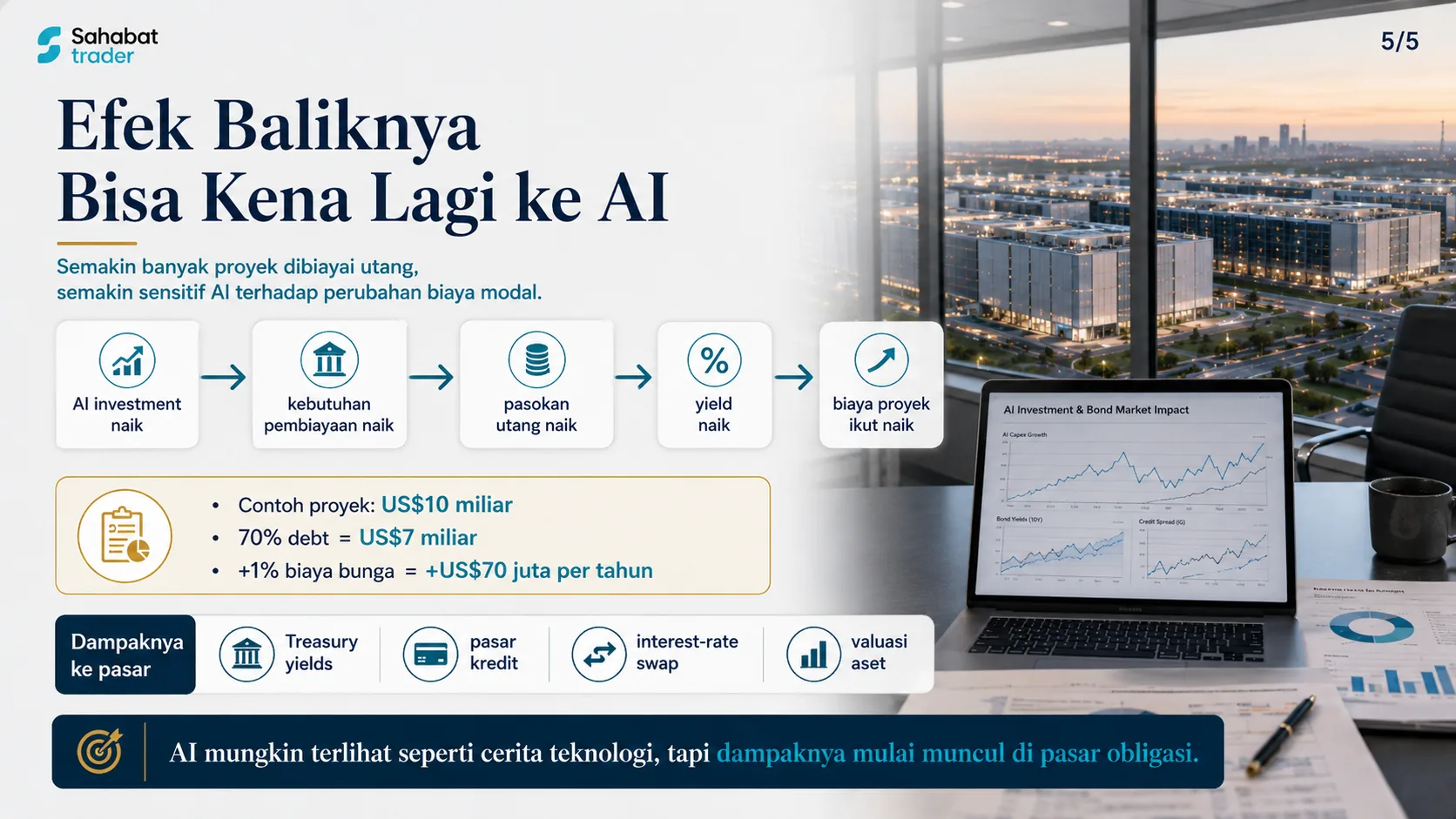
That produces a rather deep paradox: the more successful AI is at attracting capital, the more likely it is to raise the discount rate applied to its own cash flows.
The unresolved asset-life problem
There is one structural mismatch that rarely gets discussed outside credit desks.
Goldman estimates the economic life of AI silicon at only around four to six years, while data centre buildings can last around twenty years and electrical assets twenty-five years or more. Meanwhile, the debt financing it stretches out to 2066 and 2076.
That means twenty- or thirty-year debt structures cannot be underwritten on the assumption that today’s GPUs will hold their economics. What creditors are really assessing is the operator’s or tenant’s ability to keep refreshing the compute layer across several cycles.
This explains why the credit structures differ so much. Investment-grade hyperscalers can issue unsecured thirty- to fifty-year bonds because investors are lending to a diversified corporation, not to one generation of GPUs. Specialist neoclouds or single-tenant projects, by contrast, depend far more on tenant quality, lease length, power supply rights, technology refresh obligations, and residual value assumptions.
What could weaken this thesis
The thesis is not automatically correct, and several things could shrink its impact.
More internal funding. If hyperscalers keep generating enough cash to cover a larger share of capex, external debt needs fall.
Slowing AI investment. If demand for compute capacity disappoints, infrastructure spending plans can be cut.
Strong investor demand. Large issuance does not automatically mean yields jump, if pension funds, insurers, and foreign investors are willing to absorb it.
Crowding out rather than net addition. The Dallas Fed notes financial companies supplied roughly 38% of investment-grade issuance in 2025. If tech issuance displaces bank issuance rather than adding to aggregate supply, the net effect is smaller than the gross figures suggest.
Macro feedback. Higher long yields can slow investment and consumption, lowering expectations for the policy rate path. The expectations component of Treasury yields can fall even as term premium rises.
So the right formulation is not “AI will push Treasury yields up.” It is: AI financing is now large enough to be one of the structural factors in the interest rate market.
Why this matters to traders in Indonesia
Indonesia is not yet a meaningful issuer of AI debt. The exposure arrives through more indirect channels, but it is felt all the same.
Bank Indonesia held the BI Rate at 5.75% in August 2026, with the Deposit Facility at 4.75% and the Lending Facility at 6.50%, while emphasising rupiah stability amid volatile global financial conditions.
When US Treasury yields rise, the opportunity cost of holding local-currency emerging market debt rises with them. A stronger dollar or a higher global risk premium adds further pressure on the rupiah. At the same time, data centre growth across Southeast Asia can lift domestic power and infrastructure investment needs.
In other words, an AI financing boom centred in the United States can tighten Indonesian financial conditions indirectly, long before Indonesian issuers themselves become large borrowers in the sector.
What to monitor
A discussion about AI should not stop at tech share prices. A more useful dashboard covers:
- hyperscaler capital expenditure,
- AI-related investment-grade bond issuance,
- the average maturity of new corporate debt,
- 10-year and 30-year Treasury yields,
- the Treasury term premium,
- investment-grade corporate spreads,
- private credit activity in the data centre sector,
- pay-fixed swap flows,
- Treasury swap spreads,
- data centre securitisation issuance,
- project financing costs,
- utilisation rates and revenue from AI infrastructure.
The goal is not to guess how many basis points AI contributes. It is to understand whether AI financing is still being absorbed easily, or whether it is beginning to move the long-term cost of capital in a material way.
For years, the main question was who would build the best model and who would sell the chips. The next question sounds far more boring, but may be more decisive: who is going to finance several trillion dollars of infrastructure, at what duration, and at what yield?
The answer to that second question may well determine how quickly the first one gets answered.
Primary sources: Federal Reserve Bank of Dallas, research on AI financing, duration supply, and swap spreads (2026); Goldman Sachs Research, estimates of global AI investment and infrastructure 2026–2031; U.S. Department of the Treasury, Daily Treasury Par Yield Curve Rates 2026; U.S. Securities and Exchange Commission, bond issuance filings for Meta, Alphabet, Amazon, and Oracle; S&P Global Ratings, research on technology-sector debt issuance and data centre securitisation; Reuters, data centre project financing reports; Bank Indonesia, Board of Governors meeting decision, August 2026.